
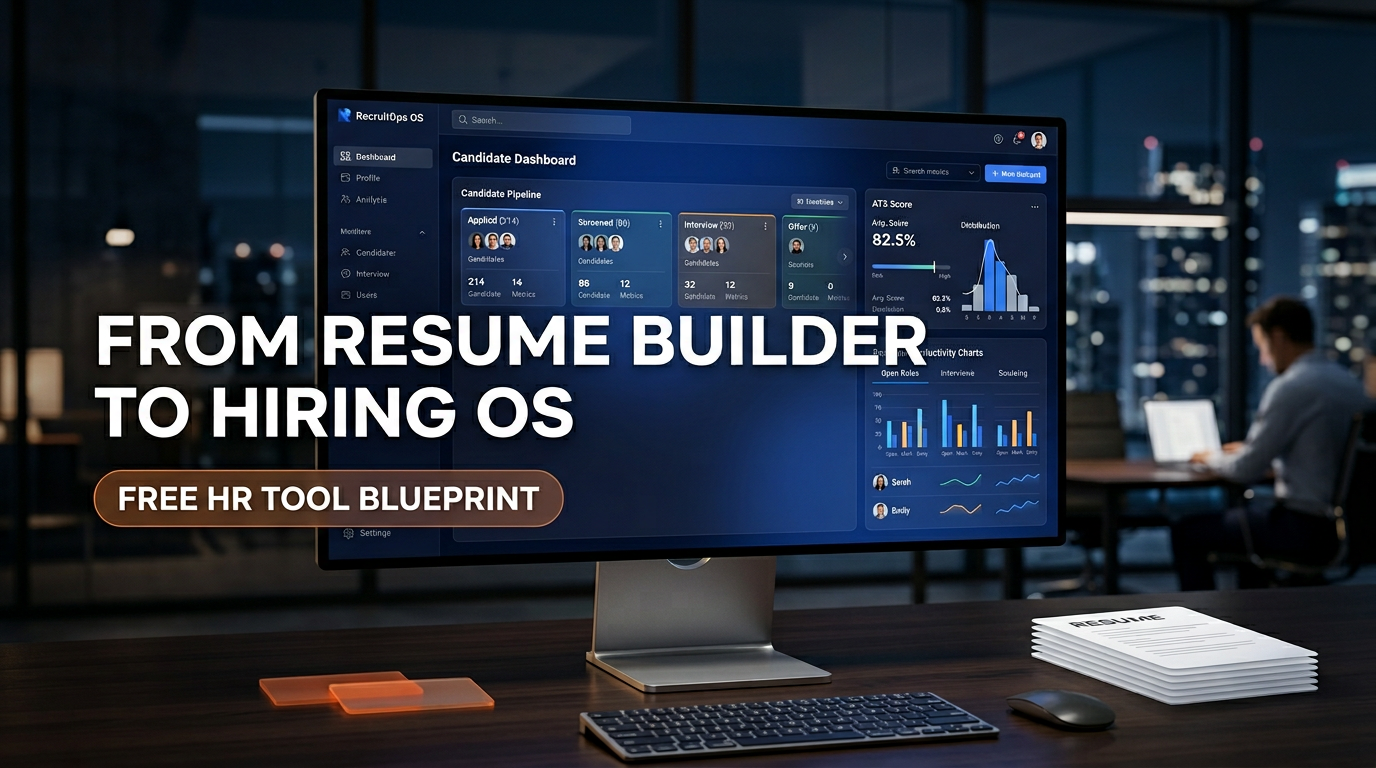
In 2026, the hiring bottleneck is not candidate volume. It is decision latency. Recruiters receive more applications than ever, while hiring managers demand faster, evidence-based decisions. A free AI resume builder looks like a consumer utility, but in practice it can be the front door to an internal Hiring OS that standardizes intake, scoring, screening, and recruiter execution.
The Real Problem in Recruiting Is Not Sourcing. It Is Throughput.
The recruiting market spent years obsessing over top-of-funnel tactics: more job board spend, more outbound automation, more sourcing channels. But the operational failure mode in most companies is not candidate scarcity. It is internal throughput collapse.
Teams now receive a larger number of applications per role, partially because candidates use AI to tailor resumes at scale. That means recruiters and hiring managers are reviewing more documents, but with less confidence in signal quality. The result is predictable: delayed shortlisting, inconsistent scorecards, interview scheduling drag, and avoidable drop-off of high-quality candidates.
If you are a talent operations leader, this pattern should sound familiar: your ATS has data, your team has process docs, and your recruiters have expertise, but decision quality still depends too heavily on individual reviewer style and manual interpretation. This is exactly where a free AI resume builder becomes strategically useful. Not as a document generator. As structured intake infrastructure.
Why a Free Resume Builder Can Be a Strategic Lead Magnet
ResumeClawd is intentionally frictionless: no signup, no email, local browser persistence, ATS feedback, and instant PDF export. That model matters for two reasons.
- Trust acquisition: HR and recruiting teams can test real workflow quality without procurement cycles.
- Data model exposure: Users experience a normalized candidate profile shape (personal, summary, experience, education, skills, custom sections) that maps directly into downstream scoring and workflow automation.
In other words, the "free tool" is the shortest path to proving product intelligence and process design quality. It answers the question buyers actually care about: "Can this team design practical workflow systems, not just flashy UI?"
The Hiring OS Thesis: Resume Builder Is Step 0
Most ATS implementations begin too late in the lifecycle. By the time a candidate enters the ATS pipeline, the resume has already been interpreted inconsistently by different humans and systems. A Hiring OS approach starts one step earlier by enforcing a common representation of candidate intent and evidence.
Step 0 is structured candidate profile capture and normalization. That is exactly what a modern resume builder can provide when paired with workflow orchestration.
- Normalize: Convert free-form resumes into consistent sections and fields.
- Score: Apply role-specific ATS and competency scoring with transparent rationale.
- Route: Push candidates into pipeline lanes based on score bands and risk flags.
- Assist: Generate recruiter guidance, interview question packs, and hiring manager briefs.
- Measure: Capture cycle time, conversion by stage, and quality-of-hire proxies.
When these steps are integrated, a team moves from reactive resume review to an operating system for hiring decisions.
Reference Architecture: From Resume Intake to Recruiter Decisioning
Below is a practical architecture pattern we use when transforming resume workflows into internal recruiting systems.
Candidate Input Layer
  - Resume builder form / import parser
  - Schema validation (required fields + date normalization)
  - Versioned profile object

AI Interpretation Layer
  - Skill extraction and role-matching
  - Experience impact scoring (metrics, ownership, scope)
  - Gap and risk detection (timeline anomalies, keyword stuffing)

Workflow Layer
  - Rule engine (role-specific thresholds)
  - ATS sync adapters (candidate create/update)
  - Recruiter queue prioritization

Decision Support Layer
  - Hiring manager brief generation
  - Interview question recommendations
  - Candidate comparison matrix

Observability Layer
  - Stage conversion analytics
  - Time-to-decision metrics
  - False-positive / false-negative tracking
Notice the important shift: AI is not used as an opaque gatekeeper. It is used as a decision-support accelerator with explicit workflow controls and measurable outcomes.
Where Most Teams Fail (And How to Avoid It)
After auditing recruiting stacks across startups and mid-market teams, we repeatedly see four failure patterns.
1) Keyword-only ATS scoring
Keyword matching is easy to implement but brittle under synonym variance and AI-generated phrasing. A robust scorer should combine lexical match, semantic similarity, and evidence weighting (for example: measurable outcomes in bullet points).
2) No confidence model
If an extraction or score has low confidence, the system should escalate for human review. Without confidence thresholds, teams over-trust automation in edge cases.
3) No recruiter UX adaptation
Many systems generate good scoring outputs but fail to fit recruiter workflow. If the guidance is not visible inside the queue and stage context, recruiters ignore it and return to manual heuristics.
4) No closed-loop evaluation
Without backtesting decisions against downstream outcomes (interview success, offer acceptance, retention proxy), you cannot improve model utility. Hiring OS requires feedback loops, not one-time prompts.
How ResumeClawd Maps to an Internal HR Tool Build
If your team is using ResumeClawd today, you already have the UX pattern for candidate profile normalization. The next step is to convert that pattern into your team-specific internal workflow.
A typical implementation roadmap:
- Week 1: Discovery and process mapping by role family (engineering, sales, design, ops).
- Week 2: Data contract definition (candidate schema, score entities, stage events).
- Week 3: ATS integration and recruiter queue orchestration.
- Week 4: Decision-support views (manager brief, score rationale, comparison mode).
- Week 5: Analytics dashboard and governance controls.
- Week 6: Pilot, calibration, and rollout playbook.
This is where the "free tool" lead magnet becomes practical demand capture. Teams test the capability in minutes, then extend to role-specific internal tooling when they see measurable value.
The Contrarian Insight: Better Hiring Usually Requires Less UI, Not More
The common instinct in HR tech is to add more dashboards. In reality, decision speed improves when systems reduce cognitive overhead. The best recruiting tools do not force users into heavy navigation. They inject high-confidence recommendations directly where decisions are made.
That is why integrations and workflow placement matter as much as model quality. Recruiters need the right signal at the moment of stage transition. Hiring managers need concise role-fit evidence, not another portal to learn. Talent operations leaders need conversion and latency metrics tied to intervention points.
When those three audiences are served in-context, your hiring workflow stops behaving like disconnected software and starts behaving like an operating system.
Measurement Framework for Teams That Want Real ROI
If you are evaluating whether to build a custom HR tool from this foundation, start with these six operational metrics:
- Time-to-shortlist (application to recruiter shortlist decision)
- Time-to-interview (shortlist to first interview scheduled)
- Reviewer agreement rate (consistency across evaluators)
- Stage conversion efficiency (screen to interview to offer)
- Recruiter hours saved per role
- Quality-of-hire proxy at 90 days
A well-implemented hiring workflow system should improve the first four metrics within a single hiring cycle and produce durable improvements by quarter two, especially when score rationale and confidence gating are tuned with recruiter feedback.
Security and Governance Considerations
For HR data pipelines, governance cannot be an afterthought. Any serious internal tool build should include:
- Role-based access for recruiter, hiring manager, and admin layers.
- Audit logs for score changes and candidate-stage actions.
- PII minimization and clear data retention policies.
- Model output explainability for compliance-sensitive decisions.
Because ResumeClawd already runs with a privacy-forward posture (browser-local persistence by default), it creates the right trust posture for teams that need controlled data handling.
What to Do Next
If your team is experiencing ATS bottlenecks, manual screening inconsistency, or interview scheduling drag, do not start by buying another generic recruiter dashboard. Start by defining your decision workflow and data contract. Then build the minimum orchestration layer that accelerates those decisions.
Use ResumeClawd as the proving ground. Measure what improves. Then scale into a custom internal tool designed for your actual recruiting process, not a generic vendor template.
If you want a concrete build path, claim the Free HR Tool Blueprint. We map your current hiring process, identify automation opportunities, and provide a practical architecture plan you can implement without disrupting live hiring.