Building a voice AI agent is no longer science fiction, but the per-minute costs can rapidly sink a profitable SaaS business if you don't understand the underlying economics of the latency stack.
Deconstructing the Voice AI Stack
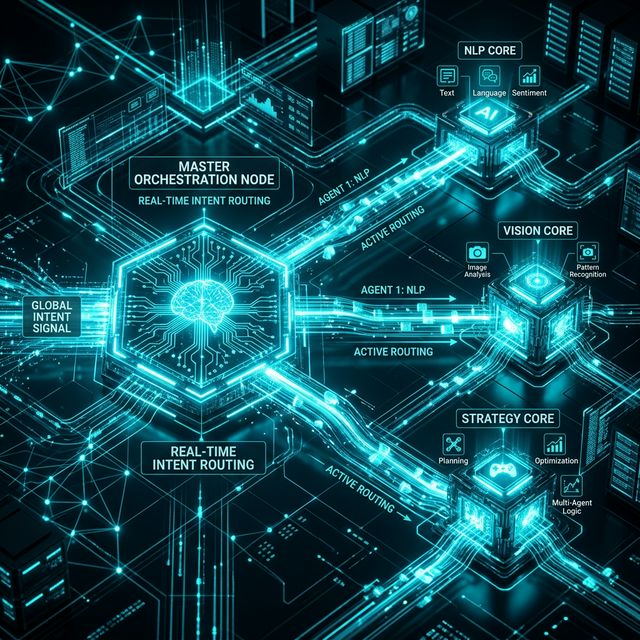
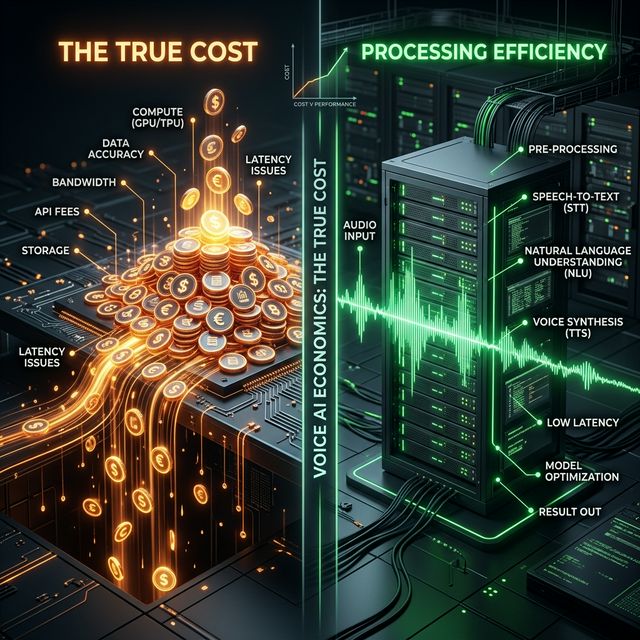
A modern real-time voice agent isn't a single model; it's a pipeline of at least four distinct technologies operating in parallel over a WebRTC connection. STT (Speech-to-Text) transcribes the user's voice, the LLM generates a response, TTS (Text-to-Speech) synthesizes the audio, and the orchestrator manages the entire state logic and VAD (Voice Activity Detection).
The Component Cost Breakdown
As of 2026, the baseline costs for these components have largely stabilized, though premium providers still command high margins.
- Orchestration (LiveKit/Pipecat): ~$0.01 per minute. This covers the WebRTC transport and necessary server compute to run the agent loop.
- STT (Speech-to-Text): ~$0.0075 per minute for high-quality streaming models like Deepgram Nova or AssemblyAI.
- The LLM (Brain): Highly variable based on verbosity, but using a fast model like Claude 3.5 Haiku or GPT-4o-mini averages around $0.003 to $0.01 per minute of active conversation.
- TTS (Text-to-Speech): The most expensive component. Premium ultra-low latency voices (Cartesia, ElevenLabs) range from $0.035 to over $0.15 per minute.
Managed vs. DIY Infrastructure
If you use a managed "All-in-One" platform like Vapi or Retell AI, expect to pay a margin of $0.05 to $0.10 per minute on top of these raw component costs. While this is fantastic for rapid prototyping, a SaaS company processing thousands of hours of audio per month must eventually transition to building in-house over LiveKit or Pipecat to protect their profit margins.
Optimize Your Voice AI Costs
Are you paying too much for your voice agents? Our engineering team designs custom, low-latency, highly cost-effective voice architectures.
Talk to our Architecture Team