
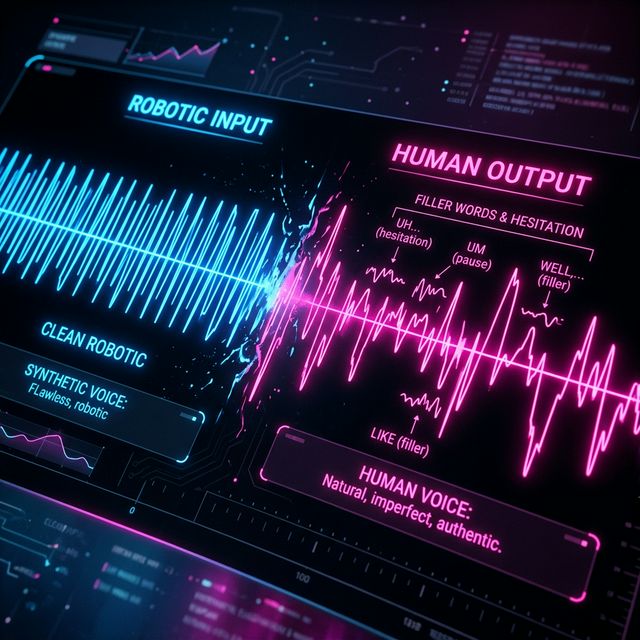
A perfectly fluent, uninterrupted monologue delivered by an AI voice sounds incredibly unnatural. Humans hesitate. We pause. We say "Uh-huh" to indicate we are listening. Injecting these imperfections is the final frontier of Voice AI.
The Uncanny Valley of Audio
If an AI responds instantly with a grammatically perfect paragraph of text, the user immediately feels they are talking to a robot. The cognitive load required to process perfect, rapid-fire audio is exhausting for humans. We expect cadence. We expect hesitation.
Engineering Filler Logic
Modern Voice AI orchestration platforms tackle this using "Endpointing and Filler Logic":
- Endpointing: Tuning the system to realize the user has briefly paused to take a breath, but hasn't finished their thought. The AI should not interrupt here.
- Backchanneling: While the user is speaking, the AI explicitly streams short audio clips of "Yeah," "Right," or "Hmm" to signal active listening, without disrupting the LLM's full context analysis.
- Pre-fillers: While the LLM is taking a heavy 400ms to process a complex query, the orchestration layer instantly plays a pre-recorded "Hmm, let me look at that..." audio file to mask the latency.
Prompting for Imperfection
Achieving this requires specific system prompts. We instruct the LLM: "You are speaking out loud. Ensure your text includes natural conversational filler marks like '[sigh]', 'well', or 'actually, wait' to make the TTS engine sound human." Combined with modern TTS engines that natively support emotional SSML tags, the result is startlingly authentic.
Design Beautiful Conversational UX
Voice AI requires specialized UX design. We help teams map complex audio interactions that feel fluid, empathetic, and uniquely human.
Improve Your Voice UX