The End of Turn-Based Chat
Classic chatbots wait for you to hit "enter." Voice AI agents must constantly listen, dynamically interrupt themselves when the user speaks over them, and stream responses in parallel chunks to keep latency under 500ms. This requires complex WebRTC orchestration.
The Case for LiveKit
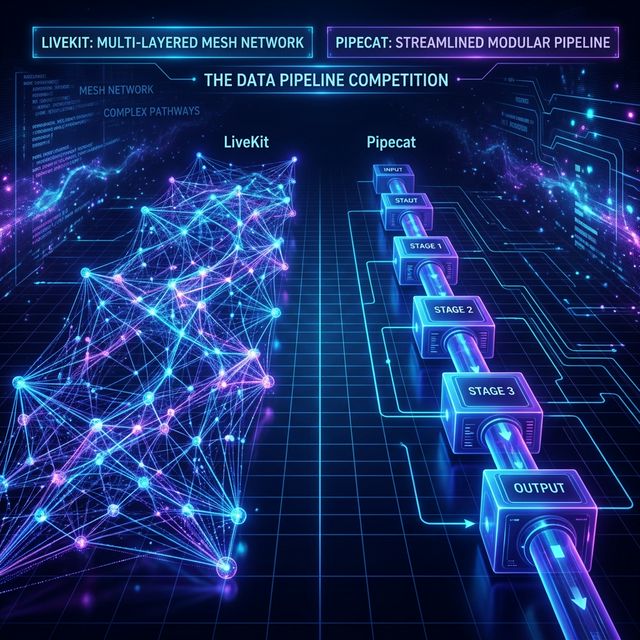
LiveKit is an open-source WebRTC project that has heavily pivoted into AI. Its "Agent Framework" provides robust primitives in Go, Python, and Node.js for managing complex room state. LiveKit shines in complex multi-user environments (like an AI agent joining a Zoom-style call with 5 human participants) due to its highly optimized SFU (Selective Forwarding Unit) architecture.
The Case for Pipecat (by Daily)
Pipecat is an open-source Python framework designed specifically for building conversational AI agents. Its key innovation is the "pipeline" concept: you string together different components (VAD -> STT -> LLM -> TTS) into frames that get pushed down a pipeline. It's incredibly intuitive for AI developers and supports dozens of providers out of the box. While Daily created it, you can run Pipecat entirely on your own infrastructure or run it on Daily's WebRTC network.
Which Should You Choose?
If you have deep experience in WebRTC and are building a highly custom video/audio application where the AI is just one participant amongst many, LiveKit offers unparalleled control. If you are specifically focused on building a 1:1 Voice AI assistant and want the fastest developer experience integrating various LLMs and TTS engines, Pipecat is currently the most elegant framework available.
Build Real-Time AI Systems
We leverage both LiveKit and Pipecat to build ultra-low latency voice agents for our enterprise clients.
Explore Voice AI Integration